نوع مقاله : مقاله پژوهشی
عنوان مقاله English
نویسنده English
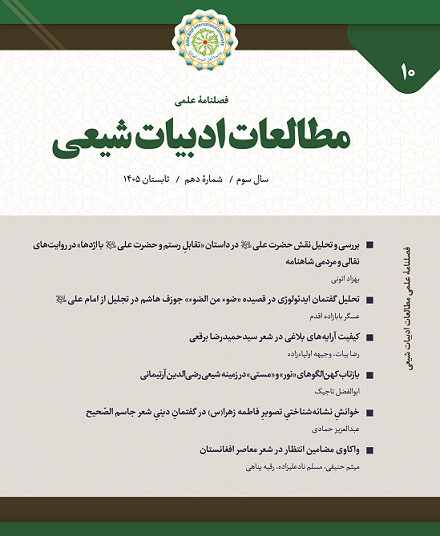
Seyyed Hamid-Reza Borqei is a prominent contemporary poet of religious verse who has published six successful and widely read poetry collections. His distinctive position among his peers appears to derive largely from his particular use of literary devices. This study examines the qualitative use of traditional rhetorical figures, particularly bayān and badīʿ, in Borqei’s poetry in order to highlight this distinction. First, previous articles and theses on Borqei’s rhetoric are reviewed, and the frequency of badīʿ and bayān figures reported in these studies is presented. The most frequently identified figures are then examined qualitatively to reveal Borqei’s distinctive rhetorical strategies. The study also identifies a number of rhetorical devices in both bayān and badīʿ that, owing to their structural complexity, have remained largely unnoticed in previous scholarship.
Borqei makes extensive and deliberate use of various forms of tanasub (semantic and lexical correspondence), while intertextuality and both explicit and implicit allusions to well-known literary works constitute another prominent feature of his poetic technique. His poetry is grounded in a distinctive epistemic framework that informs his use of hyperbolic devices; consequently, his hyperbole is not merely a conventional poetic exaggeration but is supported by a particular system of knowledge and belief. He also avoids conventional forms of simile, instead exploring subtle and unconventional modes of comparison. His frequent use of majāz is characterized by innovative and composite associative relations. Another significant feature of his poetry is the high density of rhetorical figures. At the same time, his use of familiar kināyah expressions drawn from everyday language, together with repetition, makes his highly figurative and image-rich poetry accessible and familiar to a broad readership. This combination of rhetorical richness and apparent simplicity contributes to the popular reception of his poetry and gives it the characteristic quality of sahl-e momtaneʿ: an apparently effortless style that is nevertheless difficult to imitate.
کلیدواژهها English