نوع مقاله : مقاله پژوهشی
عنوان مقاله English
نویسنده English
Abstract
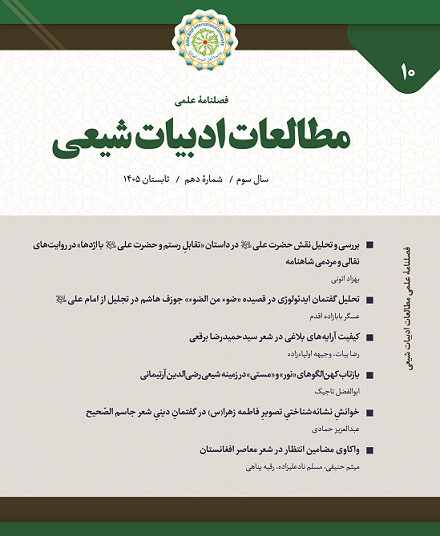
This study analyzes the ideological discourse through which the character of Imam Ali (A.S.) is represented in the poetry of Joseph Hachem, a contemporary Christian Lebanese poet. The main question of the research is how the poet employs linguistic and discursive mechanisms to move Imam Ali (A.S.) beyond the level of a historical and religious figure and present him as a justice-oriented, transreligious, and humanistic model. The aim of the study is to clarify the semantic and ideological layers of this ode and to show the role of poetry in formulating concepts such as Imamate, justice, martyrdom, historical oppression, and the universal dimension of the Alid figure. The research method is descriptive-analytical, and the data were collected through library-based research. The theoretical framework of the study is based on the components of ideological discourse analysis. The findings show that the poet, by using semantic oppositions, interrogative and negative structures, evaluative vocabulary, and religious intertextuality, reproduces discourses of justice-centeredness, ethical politics, the continuity of martyrdom, criticism of power structures, and the transreligious representation of Imam Ali (A.S.). As a result, Joseph Hachem’s poetry moves beyond conventional praise and becomes a discourse-shaping and identity-forming text that presents Imam Ali (A.S.) as a symbol of truth, justice, sacrifice, and human solidarity.
کلیدواژهها English