نوع مقاله : مقاله پژوهشی
عنوان مقاله English
نویسندگان English
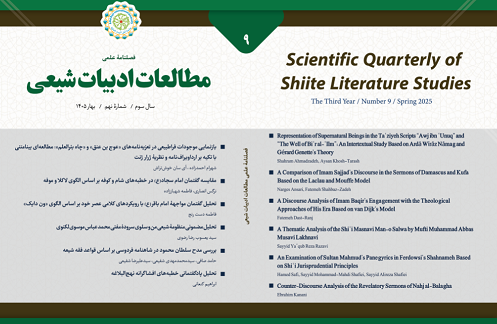
The eulogies of Sultan Mahmud of Ghazni in the Shahnameh have long been one of the most contentious subjects in Ferdowsi studies. Most previous research has approached this issue from the perspectives of literary history, Ferdowsi's biography, or the political dynamics of the Ghaznavid era; however, its analysis based on the precepts of Shia political jurisprudence has received comparatively little attention. Adopting an interdisciplinary approach, the present study utilizes documentary analysis and directed content analysis to examine the eulogies of Sultan Mahmud, drawing upon the text of the Shahnameh (the Jalal Khaleghi-Motlagh edition), historical sources, and the principles of Imamiyya (Twelver Shia) political jurisprudence. The findings reveal that Mahmud's panegyrics are not uniform in terms of structure, content, and literary function; they can be categorized into types such as ceremonial, virtue-oriented, hyperbolic, and livelihood-oriented eulogies. Consequently, their jurisprudential evaluation depends on the conditions and characteristics specific to each category, and issuing a single, uniform ruling for all these verses is incompatible with the foundations of Imami jurisprudence. The research further demonstrates that a thorough analysis of Mahmud's panegyrics is only possible through the integration of literary, historical, and jurisprudential evidence, and that a definitive conclusion cannot be reached solely on the basis of any single category of sources. The novelty of this study lies in offering an interdisciplinary framework for analyzing the praise of rulers in classical Persian texts, as well as in presenting a jurisprudential typology of Sultan Mahmud's panegyrics.
کلیدواژهها English